The Challenge: Two Very Different Stores, One Hidden Problem
Most e-commerce SEO conversations stop at blog content and backlinks. That skips the single largest organic surface Google gives a product business: the Shopping tab, the free product listings, and the product grids that now sit at the top of most commercial searches. All of it runs on one asset almost nobody treats as an SEO project. The product feed.
We manage two Shopify stores that could not be less alike. Store A is a high-ticket moissanite and diamond jewelry brand with a sprawling 1,838-product catalog. Store B is a mid-ticket fit-over eyewear brand with 207 products and a strong buy-one-get-one hook. Different price points, different buyers, different margins. We are combining them into one study on purpose, because the lesson that shows up in both is the same, and it is far more convincing when it repeats across two unrelated catalogs.
Both arrived with the same underlying problem. Their feeds were built for a human browsing the store, not for the Shopping algorithm deciding which query to show them against. Titles led with brand and style names instead of the words shoppers search. Long descriptive titles buried the product type past the point Google truncates. Attributes were incomplete, near-duplicate variants competed for the same impressions, and effort was spread evenly across catalogs where a small fraction of products drives almost all demand.
The constraint that shaped everything: in both niches, leaning on paid ads alone was not viable. Jewelry carries high cost-per-click and thin discount room; eyewear runs on a value offer with modest per-unit margin. Feed-driven organic and Shopping visibility had to carry the acquisition weight.
155M impressions, 990K Shopping clicks, and the title pattern that drove 90% of one store's sales
Product feed optimization across 2,045 products turned two neglected feeds into a compounding organic Shopping channel, and revealed a title-structure rule that held across both catalogs.
The Strategy: Treat the Feed as an SEO Surface
Classic SEO earns a position for a page. Feed SEO earns an impression for a product, in a grid where the title and the image do almost all the persuading before anyone clicks. The mechanics are different, and the product title is the single highest-leverage field you own. Google reads it to decide which queries a product can match, and shoppers read it to decide whether the click is worth it.
The plan ran on the same four levers for both stores, adapted to each buyer. Front-load intent: move product type and the highest-volume search terms to the front of the title, before brand or decorative language, so the important words survive truncation on mobile grids. Complete the attributes: fill and standardize material, gender, color and size so each product qualifies for more refined grids and stops matching the wrong queries. Surface the offer: where a genuine offer exists, put it in the title in plain words so it earns the click in the grid. And prioritize the vital few: concentrate optimization on the small share of products that actually drive demand, and prune or rework the dead tail.
The insight tying it together, and the reason both stores sit in one document: more clicks is not the goal, more qualified clicks is. A title that tells the shopper exactly what they are getting, and why, is worth far more than a longer title that buys broad, unconvinced traffic.
Store A took 1,838 products to 148M Shopping impressions on feed work alone. Our jewelry SEO service runs that play on your catalog.
The Build: Title and Attribute Work Across 2,045 Products
This ran as a rolling program, not a one-time upload. Feeds were audited, titles rewritten in priority order, attributes filled, and performance watched for two to four weeks per batch before the next round.
Title front-loading. Head-product titles were rewritten to lead with product type and the exact terms shoppers search, so the words that decide a match are never the ones cut off in the grid. Narrow, high-intent products got titles that mirror the query precisely.
Attribute completeness. Material, karat, gender, color and size were filled and standardized across both catalogs, so products qualified for more refined grids and near-duplicate variants stopped cannibalizing each other's impressions.
Offer surfacing. For Store B, the buy-one-get-one hook was moved into the title in plain language on the products where it applied. Not keyword stuffing, but putting the reason to click where the shopper sees it.
Prioritize and prune. We identified the small share of products driving most demand and optimized there first. Persistent zero-click products were reworked or removed rather than left to dilute account signals. In the jewelry store alone, 503 products had earned zero clicks and were dead weight on the feed.
Store A: High-Ticket Jewelry at Scale
The jewelry catalog is where scale shows up: nearly 148 million impressions and just under a million clicks across roughly 18 months. What the data makes unmistakable is how concentrated that demand is.
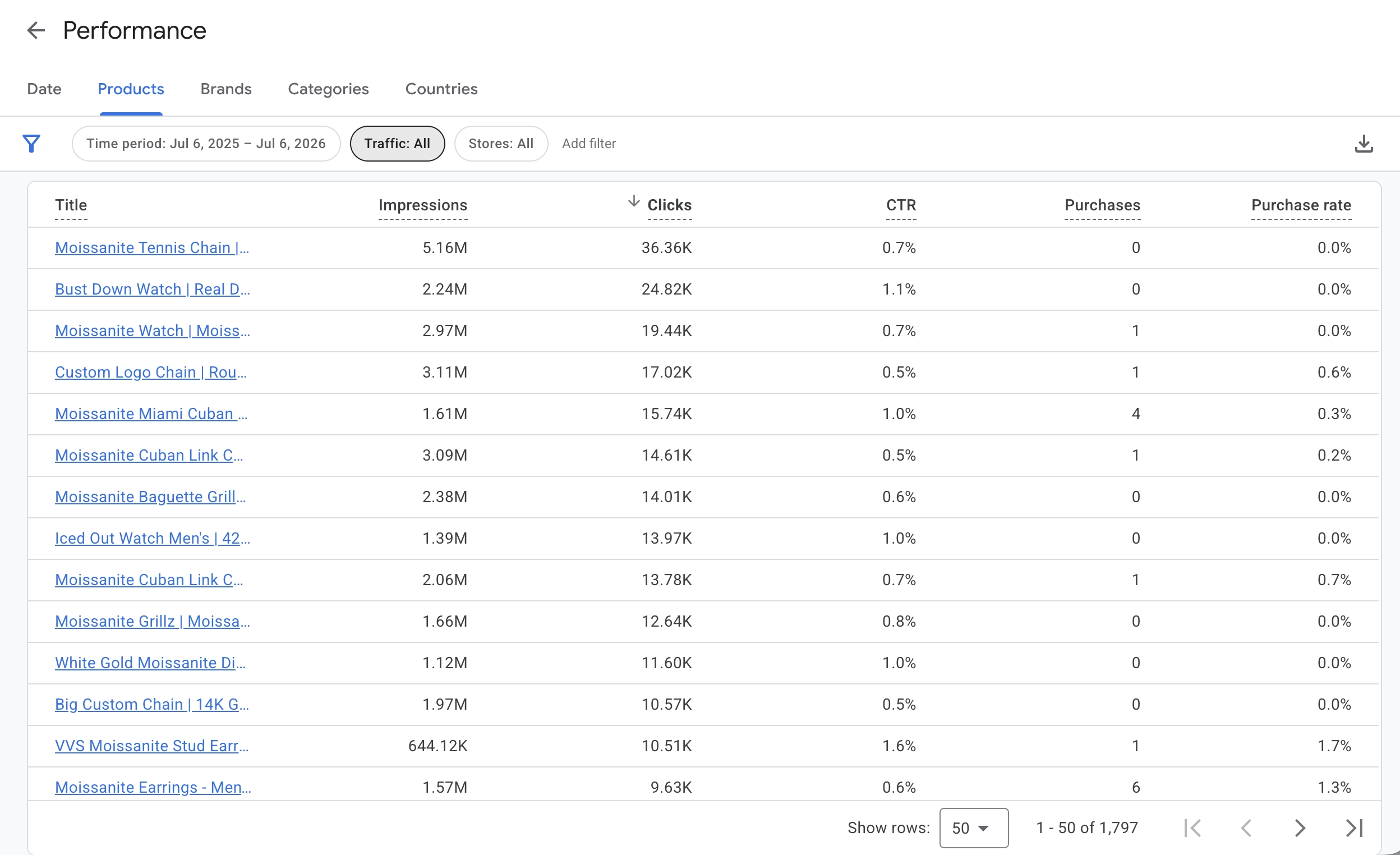
A small head drives almost everything. The top 10% of products, 183 items, accounted for 84.3% of all clicks. The other 90% of the catalog split the remaining sixth between them, and 503 products earned zero clicks in the entire window. That is not a failure, it is the natural shape of a large catalog, and it is the most actionable fact in the account: optimization effort should follow the clicks.
| Top products by clicks | Impressions | Clicks | CTR |
|---|---|---|---|
| Moissanite tennis chain (14K gold, men's) | 5,152,505 | 36,273 | 0.70% |
| Moissanite watch (42MM, mechanical) | 3,843,999 | 33,573 | 0.87% |
| Bust down watch (real diamonds, 44MM) | 2,891,783 | 32,070 | 1.11% |
| Tennis chain (VVS certified, men's) | 2,898,579 | 29,396 | 1.01% |
| Moissanite grillz (baguette, 8 on 8) | 2,570,430 | 25,201 | 0.98% |
Specific-intent titles beat broad ones on CTR. Comparing the 20 highest-traffic products against the rest of the catalog, the head earned a 0.84% CTR versus 0.55% for the tail. Narrow, high-intent products such as a specific engagement ring style or stud earring pulled the strongest click-through rates in the whole account, above 1.6% and as high as 2.8%, because their titles matched exactly what the shopper typed.
Missing attributes and near-duplicate products competed for the same grids here, and 503 items earned nothing at all. Our technical SEO service finds that waste.
Store B: The Title Test That Settled It
The eyewear store is smaller, but it produced the clearest, most repeatable lesson in the whole study. When we split its catalog by title structure, the pattern was stark.
Products with short, benefit-and-offer titles (a name, a color, and the buy-one-get-one hook) had both a higher click-through rate and, far more importantly, captured almost all of the conversions. The long, keyword-stacked descriptive titles pulled more raw clicks in aggregate but converted poorly.
| Title structure | Products | Clicks | CTR | Purchases |
|---|---|---|---|---|
| Short, offer-led titles | 153 | 9,665 | 0.84% | 183 |
| Long, descriptive titles | 53 | 41,078 | 0.68% | 19 |
Read that again. The short offer-led titles drove 183 of the store's 202 attributed purchases, roughly 90%, from a quarter of the clicks. The long descriptive titles absorbed four times the clicks and returned a fraction of the sales. The best single product, a leopard fit-over with a short offer-led title, converted at a 15% purchase rate on its clicks.
| Best converters | Clicks | CTR | Purchases | Purchase rate |
|---|---|---|---|---|
| Fit-over, Leopard, buy 1 get 1 free | 706 | 6.77% | 109 | 15.0% |
| Fit-over, Charm Leopard (long title) | 1,168 | 0.74% | 15 | 2.9% |
| Fit-over, Polar, buy 1 get 1 free | 74 | 0.58% | 10 | 20.0% |
| Fit-over, Red, buy 1 get 1 free | 79 | 1.17% | 9 | 15.3% |
The lesson, in one line: more clicks is not the win, more qualified clicks is. A shorter title that led with the product and the offer told the shopper what they were getting before the click, so the click was worth far more. Volume-first title stuffing bought traffic that did not buy.
These results came from product titles, feed hygiene, and page structure, not ad spend. Our Shopify SEO service runs the same audit and optimization for your store.
Explore Our Shopify SEO ServiceWhy It Worked
Three principles did the heavy lifting, and they transfer to any store selling physical products.
The title is the product's SEO tag
The foundationIn a Shopping grid, the title decides which queries a product matches and whether the shopper clicks. Front-loading product type and the exact search terms, before brand or decoration, is the highest-leverage change you can make to a feed. It won on CTR in both stores.
Qualified clicks beat raw clicks
The multiplierStore B proved it cleanly: short offer-led titles took a quarter of the clicks and 90% of the sales. Putting the offer and the benefit in the title pre-qualifies the click, so the traffic that arrives is already leaning toward buying. Traffic you cannot convert is a cost, not a win.
Demand is concentrated, so prioritize
The moatIn both catalogs the top 10% of products drove more than 80% of clicks. Optimizing the vital few first, and pruning the dead tail, concentrates effort where it compounds instead of spreading it thin across products the market never wanted.
The Honest Caveats
We report what the data actually shows, including the parts a polished case study usually rounds away:
Feed purchase attribution undercounts.
Merchant Center attributes only a slice of orders and weights fractional conversions, so the purchase counts here are directional, not the stores' real sales. Treat them as a signal of which products convert. Full revenue lives in GA4 and Shopify and is marked as a placeholder until pulled.
This is a performance snapshot, not a controlled before-and-after.
The figures show the outcome of an optimized feed over each window. They do not isolate feed changes from seasonality, ad spend shifts, or catalog changes over the period.
Blended feed CTR is a blunt number.
A blended 0.64% mixes free listings, Shopping placements and many query types. Product-level CTR is the more useful lens, which is why the store deep-dives focus there rather than on the account average.
The two catalogs are not directly comparable.
The jewelry store's scale and the eyewear store's offer make their absolute numbers hard to line up side by side. The value is in the pattern that repeats across both, not in the raw totals.
Disclosure: both stores are anonymized clients SEOSkit manages. Every impression, click and CTR figure here is pulled directly from Google Merchant Center Performance exports. Revenue and order-value figures are marked as placeholders pending GA4 and Shopify data.
Key Takeaways
The product feed is an SEO surface.
For any store selling physical products, the feed and the product title are among the highest-leverage organic assets you own, and most stores never optimize them deliberately.
Front-load intent in the title.
Lead with product type and the terms shoppers actually search, before brand or decoration, so the words that decide a match survive truncation in the grid.
Qualified clicks beat raw clicks.
Store B's short offer-led titles took a quarter of the clicks and 90% of the sales. Put the benefit and the offer in the title and pre-qualify the click.
Follow the concentration.
A small fraction of products drives most demand (84% and 82% of clicks from the top tenth). Optimize the vital few first and prune the dead tail.
The pattern held across two unrelated catalogs.
High-ticket jewelry and mid-ticket eyewear are nothing alike, yet concentration and title quality decided the outcome in both. That is what makes the lesson trustworthy rather than a one-off.
Is Your Product Feed Leaving Orders on the Table?
We will audit your Merchant Center feed and show you exactly which titles, attributes and products are holding you back, which products are dead weight, and where the fastest wins are. Data-driven, and we show our work.
Get Your Free Feed Audit